Sloppy Robot · Garage builds
Spend your first 100 credits on something that helps.
A bigger weapon won’t fix driving straight off a roof. Start with the problem you actually have: turning, getting shoved, running out of energy or failing to reach the other bot.
In this guide
What you start with
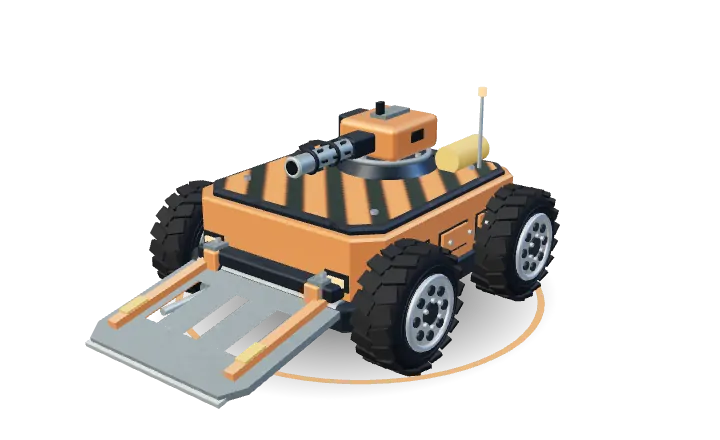
Your first machine uses the Scrapper chassis, Steel Bumper and an empty top hardpoint. The title screen’s red FIGHT button opens Fight Club. Enter the garage opens the workshop. Scrap Rat is the first NPC rival, and it is bumper-only too.
There are separate slots for chassis, front weapon, top weapon, drivetrain, armor, power and utility, plus one workshop tune. Buying a part and fitting it are different steps. Check the equipped loadout before leaving the garage.
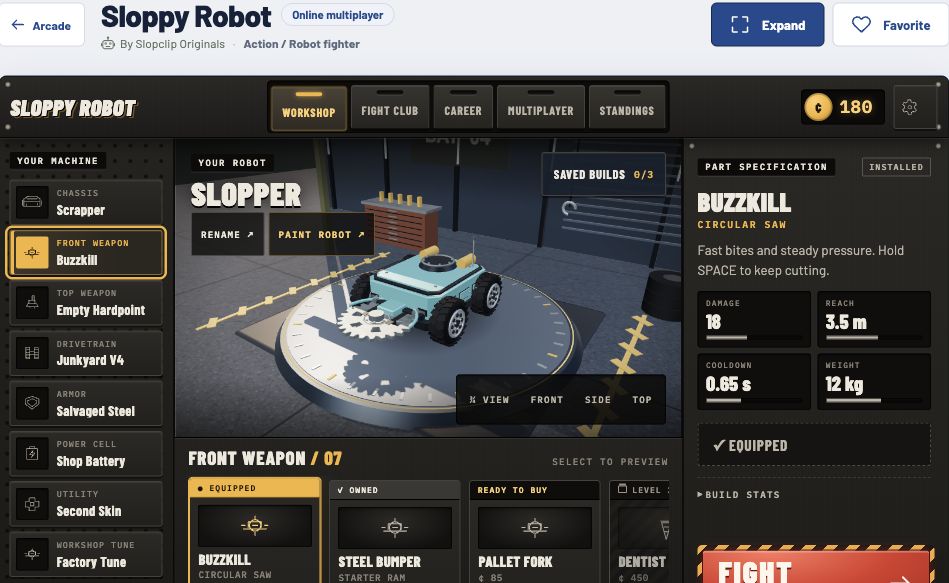
The published garage: equipped slots on the left, catalog below the robot and part statistics on the right. This existing level-2 build has a Buzzkill; it is not a fresh starter.
Five choices within the opening budget
| Part | Cost / unlock | Benefit and cost |
|---|---|---|
| Scrapyard Steering | 75 credits · Level 1 | Faster turning, at the cost of 10 hull. Try it if you keep missing your approach. |
| Salvaged Wiring | 80 credits · Level 1 | 15 more energy reserve, but slower recharge. More boost reserve does not mean endless boost. |
| Pallet Fork | 85 credits · Level 1 | Longer front reach without an energy cost; less damage and shove, with slower recovery than the bumper. |
| Patchwork Welds | 90 credits · Level 1 | 15 more hull, with added weight and lower speed. Try it if the close fight lasts longer than your machine. |
| Bumper Bracing | 100 credits · Level 1 | 15% extra shove resistance, with added mass and lower speed. Useful for holding ground; it does not stop every shove. |
Build one: the controlled starter
Keep the default chassis, bumper and drivetrain. Choose Scrapyard Steering if lining up the ram is your problem, or Bumper Bracing if you get lined up and then get pushed off. These occupy the same tuning slot; their benefits do not stack.
Use short approaches, reverse away from a bad angle, and leave room between your rear wheels and the edge. The Steel Bumper uses no energy, so you can save the battery for boost. The Pallet Fork is another affordable front option if reach matters more to you than shove.
Build two: your first powered weapon
Buzzkill unlocks at level 2 for 180 credits. Popgun, the first top autocannon, unlocks at level 3 for 350 credits. Don’t read an unlocked item as a free item: you still need the credits.
Keep the basic chassis and drive while you learn the new weapon. Front weapons use Space; top weapons use E. Popgun fires in the direction the robot faces, so turning and leading a moving target matter. Powered weapons and boost draw on your energy supply.
If you keep emptying the battery, let it recharge between attacks before buying more hardware. Quickcharge unlocks at level 4 for 450 credits and trades reserve for regeneration. That suits repeated attacks differently from a large opening burst.
Build three: push toward the edge
Eviction Notice is the hydraulic flipper: level 5, 650 credits. Crawler Tracks are also level 5, at 700 credits, and add resistance to knockback. They are separate purchases, so the pair costs 1,350 credits before other changes.
This setup is about approach and positioning. Put the rival between your front weapon and the open edge; don’t spend the energy just because the flipper is ready. A heavy-looking machine still needs space to turn, and a bad approach still leaves its side exposed.
This is a build idea to try, not a guarantee of wins. Faster opponents and different rooftops can demand a different approach.
Check what the whole loadout changes
The garage’s preview is more useful than the price alone. More hull, mass, shove resistance, speed and energy can pull in different directions. Workshop tunes are mutually exclusive sidegrades: a late unlock can still make one part of your machine worse.
- Missing the target? Look at steering and your approach before adding damage.
- Getting pushed off? Leave an escape route and compare traction choices.
- Weapons stop firing? Check energy, recharge and the fitted weapon’s requirements.
- Boosting over the edge? Use it to recover space, not as a permanent accelerator.
Compare one change in the same NPC fight. Keeping the rival and the rest of the loadout fixed makes it easier to tell what helped.
Take the garage online when you’re ready
Use your Slopclip account for online play and supported garage saves. Foundry 04 is 1v1, Freight Exchange is 2v2 and Signal Works is 3v3. Friends and party invites help you join together. Other players’ builds and the roof layout matter more than a single supposed “best” part.
Paintshop supports mirrored strokes, an eraser and undo; supported saved paint can travel into online fights. Paint, body kits and finishes are for making the machine yours. An old Robot Rage account or garage cannot transfer here.
Open the garage, or read the Sloppy Robot beginner guide and Robot Rage comparison first. Prices and unlocks describe the current packaged build and may change as the game develops.